Taking a bare piece of land and turning it into a garden retreat can give you a real sense of satisfaction. One of the main steps to making the magic happen is to learn how to arrange plants in a garden. This skill allows you to transform what initially seems like a random collection of flowers into an artwork.
This guide will help you from testing your soil to understanding sophisticated design principles. Additionally, it is packed with practical advice to help you learn how to arrange plants in a garden and keep your garden flourishing in the years to come.
Designing a garden is not just about planting stuff wildly. But it’s also more about energy and art. A good plant layout can not only trick the eye but also influence people’s emotions and change the perceived size of your property.
The design principles that work for a large green lawn are exactly the same as those for a small city courtyard. Merely following these steps will arm you with the skills that will enable you to landscape a garden that speaks loudly about your style.
Understanding your garden space
It`s impossible to create a masterpiece without knowing the canvas. That is why novices follow the advice below and then end up with plants they have to throw away because they just keep dying. How to arrange plants in a garden is a question that is well answered. A garden site analysis shares the role of a soil analysis in making a plant healthy and beautiful.
Analyze the sunlight
Sunlight is the first requirement of your garden. Track the movement of the sun on your property for several days. Which specified dwelling spots get direct sunlight for longer hours? Where in your garden do you find it dark at all times?
- Full Sun: At least 6 hours of direct light. Suitable for vegetables, roses, and lavender.
- Partial Shade: 3–6 hours of sunlight. Suitable for Hydrangea and Foxglove.
- Full Shade: Less than 3 hours of direct light. Ideal for ferns, hostas, and moss.
Test your soil
Plants health depends on good soil. Take some soil that is not too dry and not too wet. If it can break into pieces, that is most probably sand. If it forms a tight ball, that is clay. Most plants like loam, which is neither sandy nor clay soil but a mixture of both. Compost can change the content of your soil and improve the texture and drainage.
Measure your dimensions
Draw a rough layout of your garden and then add any major trees, fences, pathways, etc. Knowing the proportions of your garden will help you place the right-sized plants and trees. For example, you wouldn’t want to plant a tree near your house that will grow too big or choose a shrub that is hardly noticeable in a huge flower bed.
Principles of plant arrangement
A fantastic garden composition derives normally from a handful of art fundamentals. Those are rules preventing you from overloading your garden with things. Once you get the hang of making an appealing plant arrangement, it is just the same as painting, only your palette consists of living plants.
Color theory
Colors bring out feelings. A well-thought-out color scheme can go a long way in making the garden look like one piece.
- Analogous Colors: These colors are side by side on the color wheel (e.g., blue, purple, pink). They are associated with calm and serene feelings.
- Complementary Colors: They are on the opposite side of the color wheel (e.g., purple and yellow). This, i.e., the contrast, gives the most energy to the composition.
- Warm vs. Cool: Warm colors such as red, orange, and yellow tend to advance towards the viewer, making a large place feel more intimate. On the other hand, cool colors like blue, purple, and white recede and give an impression of a bigger space.
Texture and form
Only depending on a color can make your garden look dull, uninteresting, and two-dimensional. Texture gives a garden more than a visual aspect.
- Contrast textures: Put Hosta leaves, which are shiny, large, and smooth, next to delicate, feathery fern.
- Mix forms: You can vary the combination of plants by adding spiky, upright ones (like Iris), mounding (like Geraniums), and trailing plants (like Creeping Jenny). Such diversity stimulates the viewer’s eye to go around and be hooked.
Height and depth
It is crucial to use layers to achieve a polished and sophisticated appearance. Imagine your flower bed as a choir photo.
- Back Row: A backdrop of tall plants, shrubs, or bamboo behind them.
- Middle Row: Perennials in medium-size serve as main color sources.
- Front Row: Low-lying ground covers or border plants, are used to soften the edges.
The tiered planting method increases visibility and allows plants to receive the necessary light in your garden.
Plant selection guide
It is the garden style that determines plant picking, in large measure. Choosing plants is like telling a story; what story you tell depends on what plants you choose.
The Cottage Garden
This style is filled with charm and looks natural despite the fact that everything is well arranged.
- Key traits: Dense planting, pastel colors, and fragrance.
- Recommended plants: Peonies, Delphiniums, Roses, Lavender, and Hollyhocks.
- Arrangement tip: Rather than planting in straight lines, arrange plants in large drifts to mimic a natural flow of the wind.
The Modern Minimalist
This style prizes order, limitation, and neatness.
- Key traits: A restricted palette (mostly green and white), geometrical shapes, and repetition.
- Recommended plants: Ornamental grasses, Boxwood, Snake plants, and Agave.
- Arrangement tip: Using odd numbers (3 or 5 groups) and repeating the same plant at regular intervals creates rhythm.
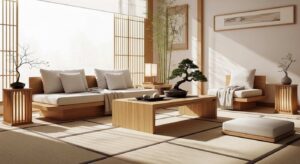
The Zen Sanctuary
This style is about quietness and getting in touch with your inner self.
- Key traits: Greenery over flowers, rocks, water features, and moss.
- Recommended plants: Japanese Maples, Azaleas, Bamboo, and Moss.
- Arrangement tip: Concentrate on the negative space. Make the distances between plants big enough for the mind to rest.
Master how to arrange plants in a garden with these techniques
After the plants have been purchased, you need to put them in certain places. Most of the time, if you put plants randomly, it will not yield good results. Here are some specific techniques that you may use to build up your layout.
Creating focal points
Just like any room requires a focal area, in your garden, the view also needs a focal point. A focal point helps the design stay together. The eyes can rest on it.
- Structural Focal Points: A statue, a birdbath, a large boulder, or a brightly colored bench.
- Plant Focal Points: An Acer palmatum in the redfall, or a giant Miscanthus sinensis.
- Placement: Your focal point, at the end of a sightline or in the center of a curve, will attract viewers and lead them into the landscape.
Balancing symmetry and asymmetry
Balance stabilizes space.
- Symmetrical Balance: You have two mirror images when you place a spiral juniper on the left side of the door and on the right. This offers a formal, stylish, and regal appearance.
- Asymmetrical Balance: This is more natural. Example is, you might have a tree on the left and on the right three medium-sized shrubs. Even though the size and number of plants are different, the visual balance is maintained. It often is the better solution when figuring out how to arrange plants in a garden for casual homes.
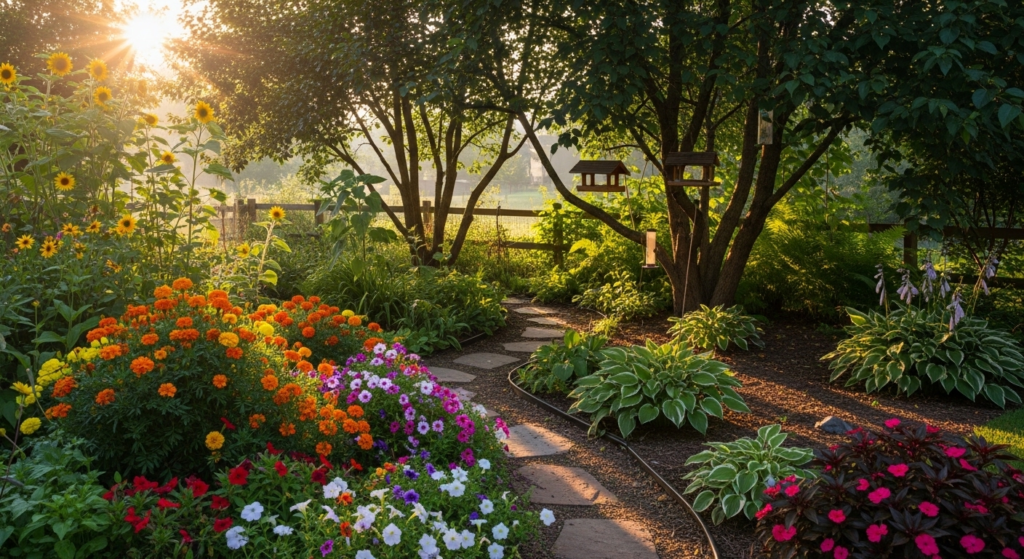
Incorporating pathways
Plants will become interactive with your steps.
- Softening Edges: Ground covers, such as Thyme or Alyssum, are allowed to spill over the edge of the pavement. It is a brilliant way to conceal and softenthe hard edges of concrete or stone.
- Scented Journeys: Along the path, you have fragrant herbs or flowers (such as Rosemary or Jasmine). You get their scent whenever you brush past them.
- Visual Stops: Low hedges could be used to line the walkway, so guests are guided towards the destination coming from the entrance.
Seasonal considerations
The first obvious error is to purchase all the items during spring when everything is in bloom. It makes for one spectacular garden in May and the dullest in October. A properly arranged garden, by arranging plants in a garden guide, will definitely be your favorite place all year round.
- Spring: Bulbs (Tulips, Daffodils) and ephemeral wildflowers.
- Summer: Heat-lovers like Coneflowers, Black-eyed Susans, and Dahlias.
- Autumn: Focus on foliage. Maples, Burning Bush, and Sedum make some lovely combos of red and gold.
- Winter: This is where the structural elements of your garden are important. Evergreens, redtwig dogwood, and river birch with peeling bark will serve as gorgeous accents in a snowy winter landscape or against a gray sky.
Plan your gardening calendar simultaneously with how to arrange plants in a garden. So that as one blooms out, a neighbour blooms in.
Maintenance tips
That arrangement you just put together needs to be looked after. When plants get too crowded, they don’t grow well and eventually die, and a beautiful design is lost.
Mind the spacing
Go through the plant label. Generally, it is an indication of the plant size at its maturity. A small container might be housing a shrub that can grow up to six feet in width. If you plant them too close, they will struggle for nutrients, and the lack of air will attract some diseases. So the best thing to do is to wait and give enough space for your plants to develop.
Drift planting
Better avoid the “fruit salad” effect, whereby you excessively buy one of everything. The look is overcrowded. Instead, plant in drifts or clumps of odd numbers (3, 5, 7). A group of five yellow Daylilies creates a great visual impact, unlike a single flower that looks lost.
Water hydro-zoning
Keep plants with similar water requirements together. It will not make sense to put a thirsty Hydrangea beside a drought-tolerant Lavender. One of the two is going to die – either the one that needs water or the other that is going to be overwatered. Separate the plants logically, and it will be both time and water-saving for you.
Case studies in garden design
Let’s examine two scenarios to verify that these concepts energize, regardless of the limitations.
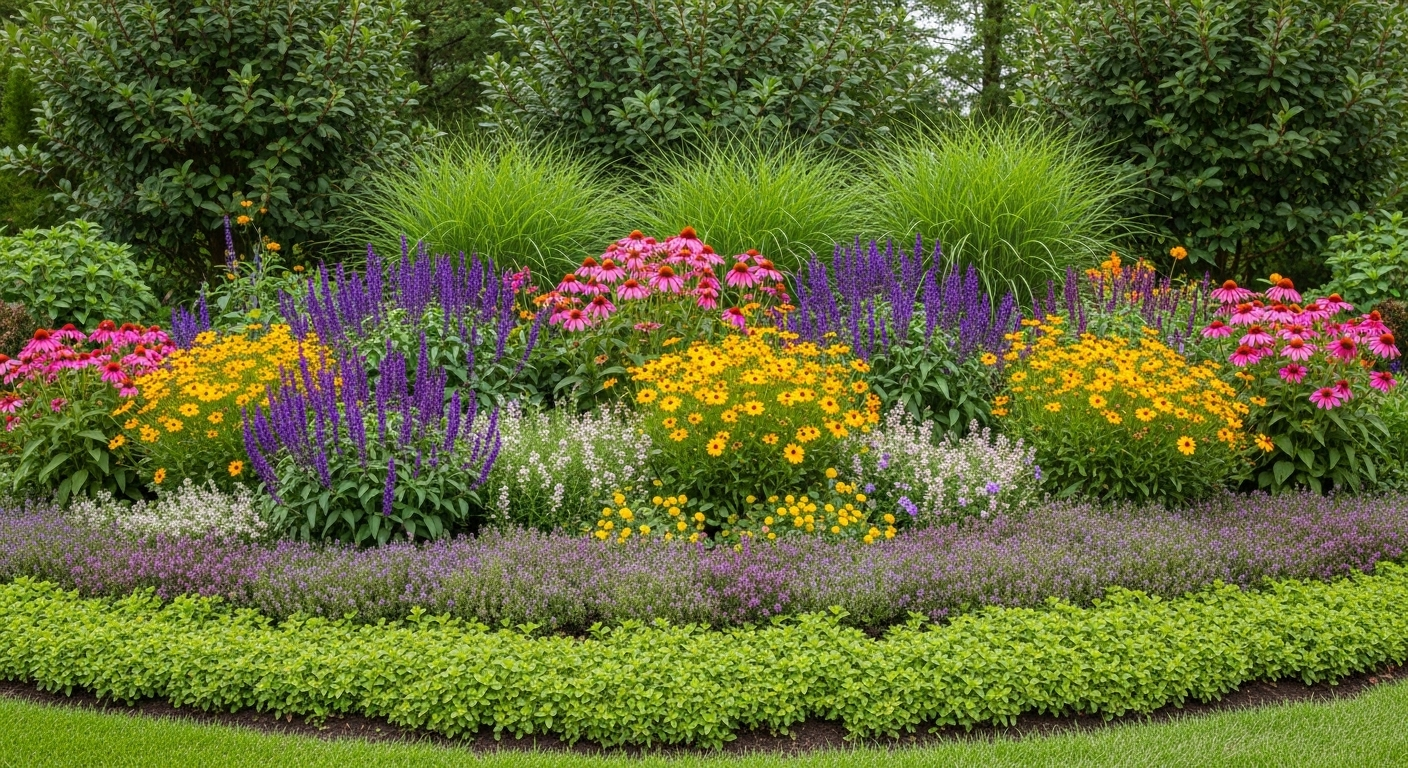
Case Study 1: The Sunny Border
The Goal: A front yard bed, vibrantly colored and easy to take care of.The Arrangement:
- Back Layer: A backdrop comes from three tall Miscanthus that provide movement and winter interest with their rust-colored foliage.
- Middle Layer: One group of five Purple Coneflowers (Echinacea) shows off its clear, vivid color. A drape of three Black-eyed Susans adds a little color and texture contrast (yellow vs. purple).
- Front Layer: Catmint (Nepeta) is a softly colored strip along the stop. The blue flowers morph this look into one of subtle elegance. Why it works: Fencing is made of complementary colors (purple and yellow), and great use is made of the layering of the heights.
Case Study 2: The Shady Retreat
The Goal: Creating a calm place under a big oak tree in your backyard.The Arrangement:
- Focal Point: Placing a white concrete birdbath slightly off-center.
- Texture Mix: The spacious, flat Blue Hostas are set around the base of the tree. Between them, delicate Ferns add a lacy texture.
- Brightening the Dark: Planting white Impatia in groups between the Hostas. White reflects the low light, making the shady corner glow. Why it works: It relies on texture and form rather than bright colors, perfect for a shade garden.
Start your garden transformation today
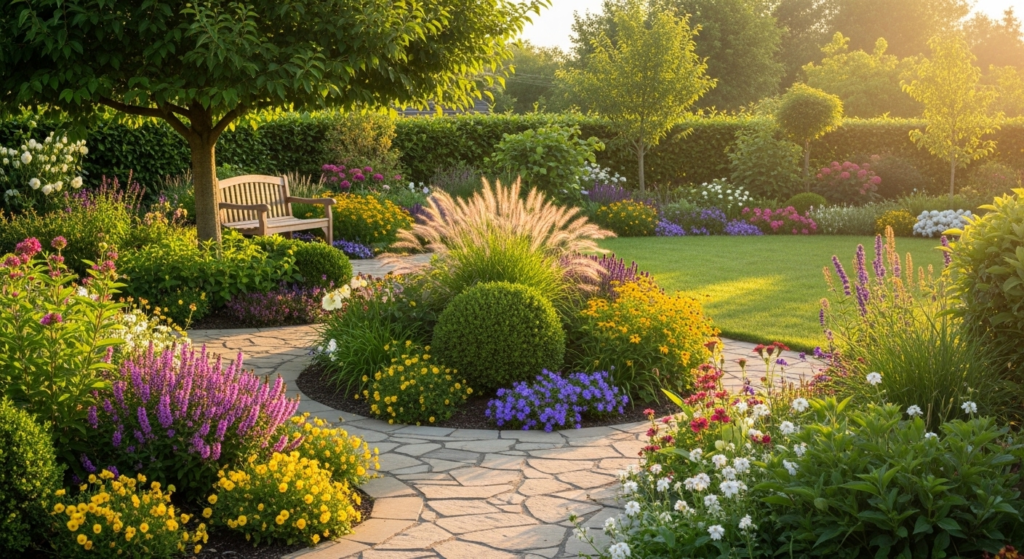
Gardening can be thought of as a journey without any particular endpoint in mind. Currently, you have acquired the skills to intentionally and stylishly arrange your plants. Beg, small. e.g,. Pick one corner of your home yard. Light analysis, selection of two or three colors, and planting in drifts will be your starting steps.
The worst thing you can do is act like a plant is dead and forget it in a corner. The best gardeners often edit their work. So go ahead and dig. Get your hands dirty. Soon, the fruits of your labors will transpire into a thriving, beautiful reality through your deliberate arrangement.